


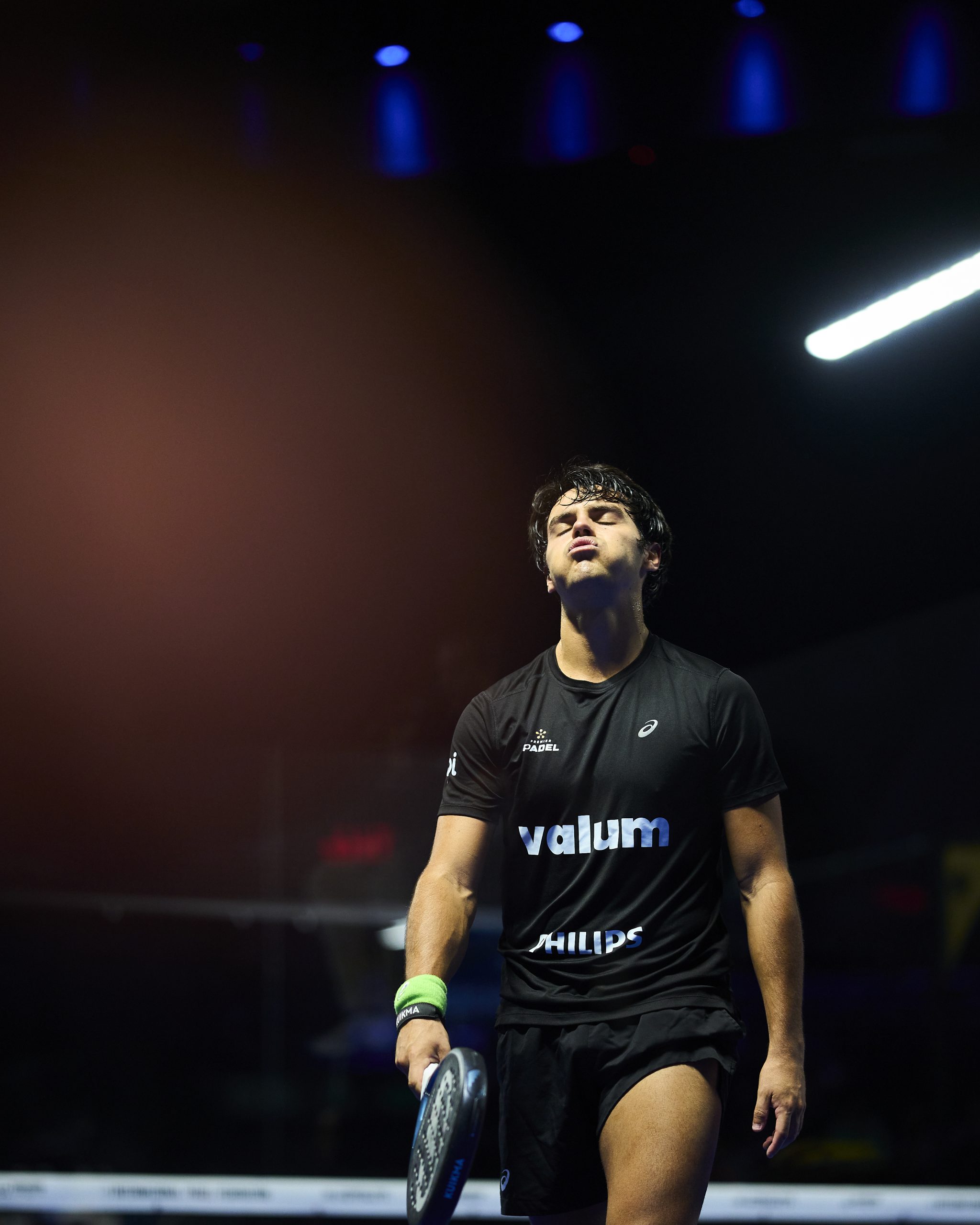
Internal dialogue is silent, yet constant. And it accompanies us at every moment. The real difference lies in the quality of thought and in how we formulate our self-expression.
by Marcello Ferrarini, coach and FITP instructor
Internal dialogue—the words we mentally whisper to ourselves and that race through our minds during a training session or a match—becomes a true performance tool. In sports psychology, this phenomenon is referred to as self-talk: the dialogue an athlete maintains with themselves through thoughts or verbalizations directed at their own actions and emotional experience.
Scientific literature and ongoing research show that internal dialogue cannot simply be boiled down to the assumption “think positive, play better.” It is a far more articulated concept encompassing instructional, motivational, cognitive, and emotional thoughts and statements that help athletes direct their behavior and maintain task-focused concentration. A meta-analysis of 32 studies revealed positive effects of self-talk interventions on athletic performance, highlighting the importance of properly training this skill rather than relying on occasional motivational phrases.
This offers a highly useful perspective for padel players: it is not about maintaining a relentlessly positive mind, but about learning to use internal dialogue that is functional to what the situation requires. The question to ask is not just “What am I thinking?”, but above all: “Is what I’m telling myself helping me play this next point better?” Therefore, eliminating negative thoughts is not enough; one must evaluate whether that internal dialogue serves a practical purpose in the moment.
Friend of foe?
In padel, before even speaking to their partner, players constantly talk to themselves, commenting on what has just transpired. It is an often silent, almost invisible dialogue that accompanies every phase of performance: before serving, during a rally, after an error, under pressure, and when the score line begins to take a clear direction.
Within this context, there is a technical-tactical language and mindset (“I need to stay lower,” “Don’t open the backswing too much,” “We need to attack more,” “What a shot I just played,” “That volée was easy”) alongside motivational or anticipatory self-talk (“Don’t miss,” “Stay calm,” “Be patient before attacking,” “Now we have to recover”). These contrasting thoughts serve wildly different functions and can surface within seconds—if not split seconds. Some are spoken aloud; others remain buried deep in our minds. Often we do not even notice them: they form part of the performance’s background noise. Yet that noise is not neutral; it is an internal dialogue that can either become a valuable performance ally or turn into one of its main obstacles.
Understanding which thoughts support performance and which sabotage it is critical. It leads to a very concrete question: “What do I tell myself when I play?” In practice, an effective exercise consists of recording—especially right after a match—some of the phrases players remember saying to themselves, analyzing their actual impact on performance. In padel, where every point demands rapid decision-making, adaptability, and the ability to stay present, learning how we talk to ourselves is almost as important as learning how to hit a proper bandeja or smash.
One of the most frequent misconceptions in mental preparation is assuming the ultimate goal is “not thinking.” In reality, completely emptying the mind during a match is impossible. Thoughts, images, evaluations, and physical sensations will continuously surface. The analytical objective of mental coaching is therefore not to eliminate internal dialogue, but to make it functional to performance.
For instance, a player might commit an error and think: “How could I miss a shot like that?” Or alternatively: “I made the wrong tactical choice. Next time I’ll stick to the simpler option.” In this analysis, the underlying technical mistake is identical. The score situation is the same. However, the second thought carries actionable information for the next point, whereas the first anchors the player to the previous mistake and feeds self-judgment.
The difference does not lie in whether one player thinks and the other does not. It lies in the quality of the thought and the voice. At times it can observe (“The opponent is starting to hit deeper”), or direct (“Let’s play a high ball and take the net”). It can certainly motivate (“Keep pushing”), but it can also judge (“You’re playing terribly”).
One can be strict with oneself or judge in a way that generates a solution. Saying “I’m playing terribly” does not explain what to do on the next point. On the contrary, it shifts focus away from the game situation and onto one’s identity as a player. It is a subtle yet fundamental distinction. Phrases like “I missed three bandejas” describe a specific behavior, whereas “I can’t hit a bandeja” defines the person. In the former case, there is a problem that can be addressed; in the latter, an internal label is created. In padel, this distinction can prove decisive, particularly when pressure builds and the inner struggle heats up.
Mastering terminology
It is clear that the words we choose alter our focus, and every phrase we formulate directs our concentration toward something specific. In conclusion, the key lies in mastering key expressions that orient our execution toward what we can actually and realistically control—becoming immediate attentional anchors that prevent us from being swept into the past or the future right when our sole objective is staying grounded in the present.
Using effective self-talk tools allows us to avoid stepping onto the court every time with an invisible, obstructive partner: ourselves.