

With marketing and the idea of consumers as actors to interact with, and not as purchasing machines. For this reason, it is essential to integrate “push” and “pull” activities to stimulate competition and loyalty, like the Battle Padel
by Adelio Rosate, team and marketing manager of O&B Padel
We have stated it several times, but we reiterate: marketing is an essential discipline also for padel, not only for consumer marketing but especially for those who manage services. This emerges increasingly from the in-depth studies of O&B, which you can find in previous issues of Padelbiz, where the delicate and central role of the center in the sports culture of this discipline has been emphasized. Supporting the idea that it is indispensable in any market is also one of the leading scholars in the field, Philip Kotler, but in this context, we also want to take up the theses of Giampaolo Fabris, who wanted to give a sociological perspective to the subject, inspired by the transformation of the consumer. His assumptions are expressed in his most representative study, Societing. Marketing in the postmodern society, in which one of the ten theses presented states that “marketing must be aware of operating within society. Consumers are social actors to interact with, not purchasing machines”.
On our part, the role of raising awareness towards marketing makes us aware of the challenge it entails. As we have seen, while there is a wide and varied literature on this, there is no trace of its application in the world of padel. Therefore, taking this on ourselves, we are helped by the firm belief in the usefulness of the considerations that emerge from analyses inspired by this methodology to be concrete indications for the numerous entrepreneurs who embark on this adventure. We see them focused on the most hi-tech communication tools, but less on the object of communication itself and on strategies functional to the players’ expectations and the achievement of their goals.
We also understand the skepticism that we sometimes seem to perceive when talking about this in the centers of the various cities we visit. This fact raises some doubts about the usefulness of convincing them of this methodology. But these doubts are soon dispelled when we make a basic consideration: how much does a padel court cost, the cover, the rental of a shed (or worse, the purchase)? What is the total investment amount? What are the estimated times for the economic return? Profit expectations post-amortization? Given that many investors have devoted themselves full-time to this sport, we recommend that they make use of all available tools and leave nothing to chance.
Pull or push?
In the last issue, we identified the direct and indirect services of a center. Now we try to establish what the optimal steps are to develop and make them perceived by users (player-consumers). Each service, direct or indirect, responds to relative and distinct actions, divided into moments of “push” (pushing consumers towards a product) and “pull” (the action of attracting consumers to oneself, so that they move actively). From the observation of the most successful centers, the pull action that is confirmed to be the most effective is the school (not to be confused with individual lessons), as confirmed by the experience of some centers and their teachers. Above all, Ariel Mogni, founder and director of several successful centers in Tuscany, and Andrea Fierro, a teacher at Star Padel in Legnano.
The school is the pull product that allows to achieve more short and long-term goals, also contributing to the coverage of slots. It increases the overall technical baggage of the attendees, encourages competition and the implementation of tournaments. It promotes the knowledge of this sport in those youth groups, often already oriented towards more traditional ones. Last but not least, it also strengthens the demand in a less immediate future. With the possibility that it may bring out some players at a national level.
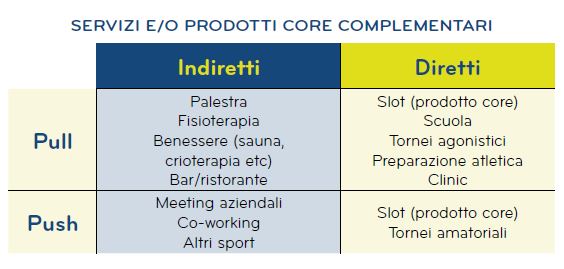
Services are considered complementary to the “core” product, namely the court slots. From the analyses carried out, we feel it is advisable to keep the number of indirect services low, so that users perceive better the specific offer for padel
Returning to marketing, if the school is certainly a pull product within the center’s offer, there is a second one that requires daily commitment for the “saturation of the facility”, namely WhatsApp chats, which every center has equipped itself with. A tool that is more difficult to allocate distinctly between push and pull. On one hand, it encourages members to play, but on the other hand, it “pushes” for an immediate solution to complete a quartet for a match. Although in a somewhat unorthodox way, we could define it as hybrid. This tool has recently been the subject of innovation, with a proposal that synthesizes between the standard chat and the tournament. A 2.0 chat if you will. We are talking about the Battle, a platform that aims to encourage competition and can be easily integrated into the centers. We interviewed its inventor, the civil engineer from Brescia, Mario Castiglione, to tell us about it.
The interview
Mario Castiglione, creator of Battle Padel
Mario, what is Battle Padel?
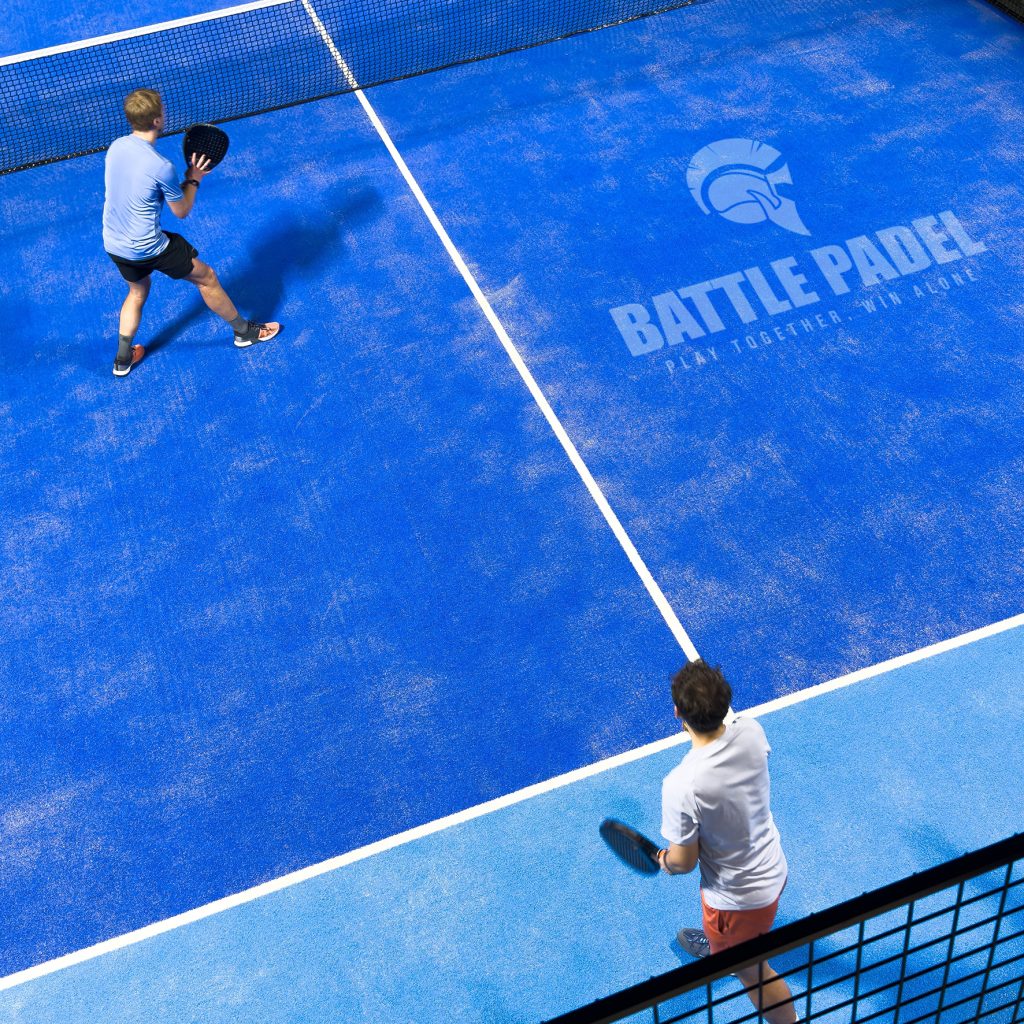
The slogan Play Together, Win Alone explains it all. It involves three different matches in which players rotate, so that everyone competes against each other. Through the monitoring of each result, the ranking of each player is updated
and the ranking is drawn up. It is a system that considers all variables to make it as objective as possible, with the aim of creating levels so that matches are in line with the players’ potential. It is a formula that aims to stimulate soft competition among amateurs and implicitly generate collaboration with the center.
Where have you tested the format?
We were born in November 2024. We started in the Brescia area, playing at home, first with the help of my brother Leonardo and then also of Simone Verzeletti. Now, thanks also to the collaboration of Max Bertanza, we are developing in the province of Bergamo, to explore in the very near future also Milan. We are also moving outside Lombardy, trying to select “pioneering” centers.
What kind of center would you ideally like to involve?
It is clear that at this stage we consider any participation in the project interesting. However, from the experience gained in this first year, we can say that we find greater adherence in small centers, with a maximum of three to four courts, where the management of the center itself is also simpler.
What is the format of the Battle?
It is a booking software, as well as a tool to achieve “saturation” of the slots. The center provides the courts and the player signs up based on their availability, without the burden of having to find three other players. Depending on the number of open courts, players are placed in descending order of level, playing three mini-matches with each of the court mates. Once the normal 90-minute slot is over, the software draws up an individual ranking for each court and, in case of multiple courts, a general individual ranking based on the points earned, but elaborated according to the difficulty coefficient. Winning a match or just some games on the lowest level court is not the same as doing it on the highest level court.
How do you differentiate yourself and how do you integrate with the most famous booking apps on the market?
I would say we could be complementary. We do not have a management system and I believe that our format is more sophisticated in terms of indicators, which allows us to define the player targets and consequently their levels.
What do you foresee for the future of Battle Padel?
In the short term, thanks also to the team that has been formed, Battle Padel will try to spread on the Italian market by offering itself as a free trial software for new centers and with online tutorials, while in Brescia we are already working on a second phase, with spin-offs such as Battle Padel Events. The first part will be managed via email and social media, while the development of the spin-offs will be possible thanks to the intervention of passionate players who will want to be part of the team.
Is the format paid?
The company that owns the software currently sustains itself through contracts with padel centers. Each Gold center (after the trial period) pays a small fixed annual contribution and then a small fee, based on the slots filled. This accounts for about 10% of the center’s turnover, while for players registration is completely free.
In your opinion, what are the resistances of the centers towards these tools due to?
We are in a phase of market evolution, with a varied profile of managers, many of whom mainly conceive a “do it yourself” method and do not see the potential of certain projects. The Battle, for example, contains an intrinsic opportunity: the outsourcing of one of the center’s activities, namely the organization of matches and slots.
What is the current state of the art?
The platform has about 2,800 registered users, while there are about thirty affiliated centers, and of these, about twenty are already active, meaning they systematically propose Battles.
O&B Padel is a specialized observatory in padel-related marketing. It conducts targeted surveys and studies on national and international markets, defines attraction areas for centers and academies, and proposes market estimates and dedicated business plans. Those who wish to delve into our work can contact us at the email address: arosate@yahoo.com