



Let’s continue our investigation with the centers to understand their strategic choices and economic management. Two types of critical issues are emerging: structural and cultural
by Adelio Rosate, team and marketing manager of O&B Padel, and Giacomo Cirelli, manager of O&B
“Our prices are as follows: 6 euros in the morning and 9 during peak hours.” To dispel any doubts we may have while reading the price list of the slots, there is Claudio Forte, director of the Seven Padel Village in Siracusa. Prices that could contrast with the significant investment required to create the largest center in Sicily and one of the largest in Italy (with 12 courts, 10 of which are in a single large covered structure, built under the guidance of Leonardo Ravizzini). “We want everyone to be able to play,” Claudio adds. We are pleased to find concrete evidence of what we have been advocating for some time (see Padelbiz n.6/2025 which addresses the theme of corporate culture in centers). In Claudio and owner Giuseppe Terranova, we see awareness of the role and responsibility, which should be a key characteristic of a large center. A vision and foresight that are not taken for granted. In our opinion, padel should be able to offer affordable prices. Certainly at least 10% below 15 euros per slot per player. Although the cost of living in the South is lower than in the North, the reasons that allow for these prices, as we will see, are attributable to a different marketing approach. In the North, on the contrary, there is a tendency to overestimate the “positioning” of the offer and to consider the product as “premium”. Due to its origin and history, it is a popular sport. The opportunity to practice it must be consistent and not exaggerated. The reasons why the opposite happens are only partially understandable, despite being aware of the investment required to set up a center (almost doubled in recent years). As already emphasized, the history of marketing teaches us that as a market matures, it is increasingly influenced by the price variable. Having overestimated prices can slow down or even compromise the growth trend, which still has potential. It should be remembered that in Italy, this sport involves 1% of the population, compared to 10% in Spain. Growth is not only possible but necessary because the absolute values contribute to overcoming some of the current critical issues. In Spain, it is estimated that the cost of renting courts is on average about 30% lower. The Italian market must therefore trigger a virtuous circle. A circular action that, starting from economies of scale, can lower prices for the public, favoring the expansion of demand for the growth of enthusiasts and game frequency. Today we have over 10 thousand courts distributed in about three thousand centers; an average of just over three courts each. The larger ones, with five courts or more, are often “weighed down” by complementary services/products not focused on the core business, diverting attention and resources from it. Paradoxically, sometimes the cost is higher here. But let’s take a look at these prices. 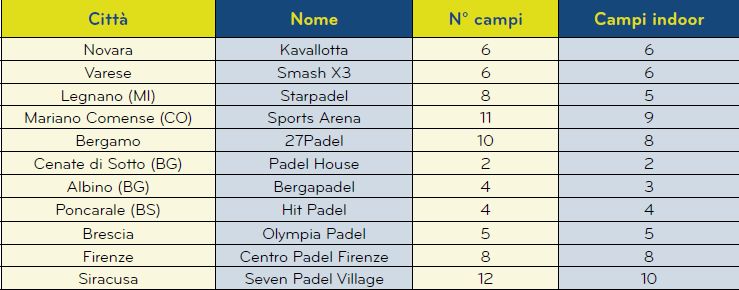
Slot prices
From the survey, we confirm uneven prices (table 2). Already in our limited sample, we see prices ranging from 5 to 16 euros for an average between 11.57 euros and 13.8, where the impact of the Seven Padel Village is significant. Expanding the survey would result in an even higher average price. Paradoxically, in Lombardy, we find that prices in smaller centers are lower: this means that those who have the possibility (8-10 courts) do not generate the correct economies of scale, probably inspired by an approach that positions them at premium levels. With these medium-high prices, a very promising segment in the future is also compromised, namely the youth. 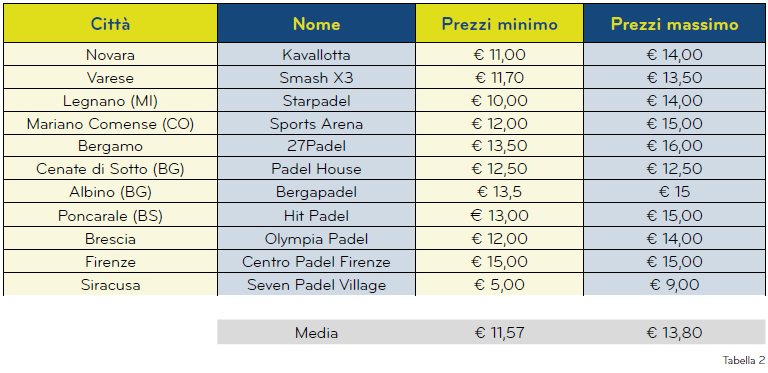
Current management
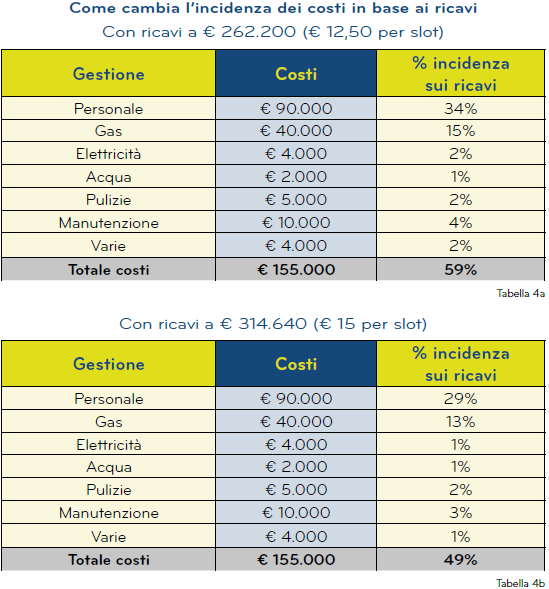
We asked the centers what are the costs with the greatest impact on the financial statement related to ordinary management. The answer? Personnel and the main utilities, namely gas, electricity, and water. To make them more representative, we hypothesized to relate them in a synthetic income statement, to two revenue hypotheses, related to those likely of a center with three courts (and a daily average number of slots per court equal to five). 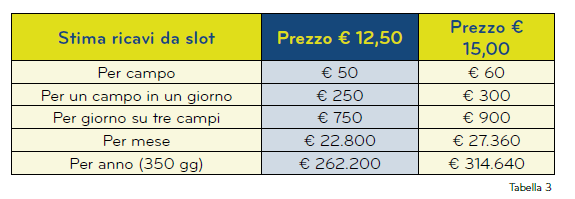 For gas, the difference in average temperatures can certainly lead to different management costs between the North and the South. However, this cannot justify the differences we observe in the slots’ total cost. While the cost of personnel is influenced by another aspect, influenced by the type of teaching. We find two distinct types in its organization: • direct, where teachers and instructors are employees of the center and remunerated by it; • outsourced, where the team of teachers (in many cases only one instructor or teacher, therefore not a school) is autonomous in the proposal and approach. This second option is understandably chosen by small centers.
 A direct and well-structured school, however, is another essential component for medium-large centers (from eight courts upwards), which must be able to offer group courses (even simply amateur), provide classes at different levels, from beginners to intermediates and competitive players, as suggested by our expert teachers (Ariel Mogni, Andrea Fierro, and Sarah Martignoni, to name a few). It must be able to offer not only the individual lesson at 50 euros but also, accessible to all, especially at the basic level. If well organized and qualified, the school is indeed the best business card for the club. Ariel Mogni has made it his mantra in his Padel Firenze Center: “The first thing I focus my attention and time on is organizing and overseeing the school. I cannot think of delegating the strategic key of the center to others.” We see in some centers many wasted resources: too many tournaments, some of which are not very qualified, with which managers understandably want to saturate the slots. Prioritizing a tactical action instead of a strategic one (the school) in projection risks being detrimental.
A double problem
In summary, the development of the trade is a structural and cultural problem. • Structural, because the network of centers, as already mentioned, is on average made up of small clubs or with an average (for non multisport) slightly above three courts. • Cultural, because there is a widespread tendency, especially in the North but not only, to consider it as a premium, niche sport, accompanying the primary product (padel itself) with a series of products and services often unrelated (see our analysis on complementary products offered by the sports center on Padelbiz n.6/2025). The most common is to equip it with a structured restaurant (in some cases even sophisticated), when most of the time a bar with fast food would be sufficient, as some of these teach us. In this way, the risk is to generate a reversal of the marketing “product portfolio” structure, where padel goes from being the core to a mere tactical product of attractiveness. Yet, there is an unequivocal benchmark, which we have already mentioned and to which we should refer: Spain. Where the centers are generally spartan and where you go to learn and/or play padel, period. And where, as we say again, the average price is significantly lower than ours. The survey reveals an Italian approach that is still somewhat provincial and naive. The managerial approach is still lacking, with little focus on the possible segmentation of its users (by age, gender, residence, and frequency of play). Information that is already available (bookings, memberships, etc.) but remains an unused tool. Yet, it would not be complicated to add to the booking device (often an external tool) a database from which, with a simple pivot table, precise and useful information can be simultaneously extracted to promote targeted initiatives. At the same time, this tool would serve for periodic analysis and checks against planned objectives. In the next issue of Padelbiz, we will continue to delve into the management aspects of the centers, focusing on the procurement of financial resources and emphasizing the importance of the school.


